Emotional Development in Children: A Parent's Guide for Ages 3 to 12
Watch a four-year-old wrap her arms around a crying friend and you're seeing emotional development at work. The CDC lists exactly that, comforting others who are hurt or sad, among the skills most children show by age 4 (CDC). Feelings are learned the way walking and talking are learned: in steps, with lots of practice and plenty of stumbles.
This guide covers what to expect from ages 3 to 12, how to help at home without turning every meltdown into a lecture, and a few activities that give kids low-stakes practice. There's a free feelings chart to print, too.
TL;DR: Emotional development is how children learn to notice, name and manage feelings, and to read other people's. The CDC says most children comfort upset friends by 4 and take turns in games by 5. After that, friendships and self-control take center stage. Name feelings out loud, accept the feeling while limiting the behavior, and practice through play.
What Is Emotional Development in Children?
Emotional development is the slow work of learning to notice feelings, name them, manage them and recognize them in other people. CASEL, the nonprofit behind many school social-emotional programs, describes it as learning to "manage emotions," "feel and show empathy for others" and "establish and maintain supportive relationships" (CASEL).
CASEL splits those skills into five areas: self-awareness, self-management, social awareness, relationship skills and responsible decision-making (CASEL framework). You don't need to memorize the list. It's just a useful reminder that "handling feelings" is really several skills growing side by side.
The American Academy of Pediatrics puts it in more everyday terms. Its four building blocks of healthy emotional development are safe, stable relationships at home, open communication, learning to understand and manage emotions, and social relationships at school or in the community (AAP, HealthyChildren.org).
So where does a child's emotional toolkit come from? Mostly from the adults around them. Harvard's Center on the Developing Child calls the back-and-forth between a child and a caring adult "serve and return," and notes that "naming what a young child is seeing, doing, or feeling helps make important language connections" (Center on the Developing Child). Every time you say "you look frustrated," you're teaching.
What Emotional Milestones Should You Expect at Each Age?
The CDC's milestone checklists spell out what most children do socially and emotionally by ages 3, 4 and 5 (CDC). After 5 there's no official checklist, so the changes are easier to describe as themes: friendships, fairness, self-control and empathy. Every child moves at their own pace, and a skill that shows up late isn't a verdict.
| Age | What you'll often see | Try this |
|---|---|---|
| 3 to 4 | Joins other kids in play; calms down within about 10 minutes after a goodbye | Name the feeling out loud: "You're sad I'm leaving." |
| 4 to 5 | Comforts friends who are hurt or sad; likes to help; pretend play | Give real jobs, and play out feelings with toys |
| 5 to 6 | Follows rules and takes turns in games | Simple board games and bingo, including losing |
| 6 to 8 | Friendships matter more; big anger at friends | Coach calm ways to show anger, then talk it through |
| 9 to 12 | Reads other people's feelings; works on handling stress | Ask how others felt; plan for hard moments ahead |
Ages 3 to 4: Joining In
By 3, the CDC says most children calm down "within 10 minutes after you leave," like at a childcare drop-off, and notice other children and join them to play (CDC). That's a big leap from parallel play. Feelings still arrive fast and loud at this age, and they're usually over just as quickly.
Ages 4 to 5: Caring and Helping
This is the year empathy shows up in behavior. The CDC's list for age 4 includes pretending to be something else during play, comforting others who are hurt or sad, liking to be a "helper," and changing behavior based on the place, like a library versus a playground. Pretend play is where a lot of feelings get rehearsed: the stuffed dog gets scared of the dark so your child doesn't have to.
Ages 5 to 6: Rules and Turns
By 5, most children follow rules or take turns when playing games with other children, according to the CDC (CDC). They also sing, dance or act for you and do simple chores like matching socks. Games with rules are hard work at this age. Waiting your turn, and losing, both take real self-control.
Ages 6 to 8: Friends Matter More
School brings a wider circle and bigger stakes. The AAP puts it plainly: "Even from the very start, children get very angry with friends," and that gives parents a chance to teach how to feel anger "and express anger without verbally or physically hurting others" (AAP). Expect strong opinions about what's fair. That sense of fairness is a skill in progress, even when it sounds like complaining.
Ages 9 to 12: Empathy and Self-Management
Preteens get better at seeing a situation from someone else's side, and that helps with their own feelings too. "Recognizing the viewpoints and feelings of others helps kids learn to manage their own emotions," the AAP notes. This is also when CASEL's "self-management" skills, like handling stress and waiting for a reward, get a real workout.
How Can You Support Emotional Development at Home?
The first tip on the American Academy of Pediatrics' list is simple: "Put your child's emotion into words," like "You look mad/angry/scared/disappointed/frustrated." A named feeling is easier to manage than a nameless one. Here's how that looks day to day.
Name the Feeling, Then Wait
Say what you see, in a sentence: "You're disappointed the park is closed." Then pause. You don't have to fix it right away. Kids who hear feelings named often enough start doing it themselves, first about characters in books and later about their own day.
Accept the Feeling, Limit the Behavior
The AAP suggests telling children that "emotions are OK, even if behavior is wrong," with a line like "It makes sense that you feel [emotion] because of [reason]." Being angry at your brother is fine. Knocking over his tower isn't. Both parts of that message matter.
Get Calm Before You Get Talking
A child in the middle of a meltdown can't take in advice, and honestly, neither can most adults. Lower your voice, get down to their level and wait for the wave to pass. The lesson lands better an hour later, when you can talk about what happened and what might help next time.
Make Talking a Daily Habit
Open communication is one of the AAP's four building blocks for a reason. Short, regular check-ins beat one big talk. The car ride and bedtime are good spots, since there's no eye contact pressure. Try "What was the best and worst part of today?" instead of "How was school?"
Play It Out
"Play lets children explore emotions even before they have the words to express themselves," the AAP says. Puppets, dolls, drawing and pretend games let kids try on feelings at a safe distance. If your child's teddy bear is always angry at bedtime, that's worth a gentle question.
Which Activities Help Kids Practice Emotional Skills?
Play is where emotional skills get their practice. The AAP notes that play gives children "a sense of control in their world." Each activity below takes about ten minutes and needs nothing more than a printer and some crayons.
Color a Feelings Chart
We drew this feelings chart for this guide: six faces for happy, sad, angry, scared, surprised and calm. It's free to print.
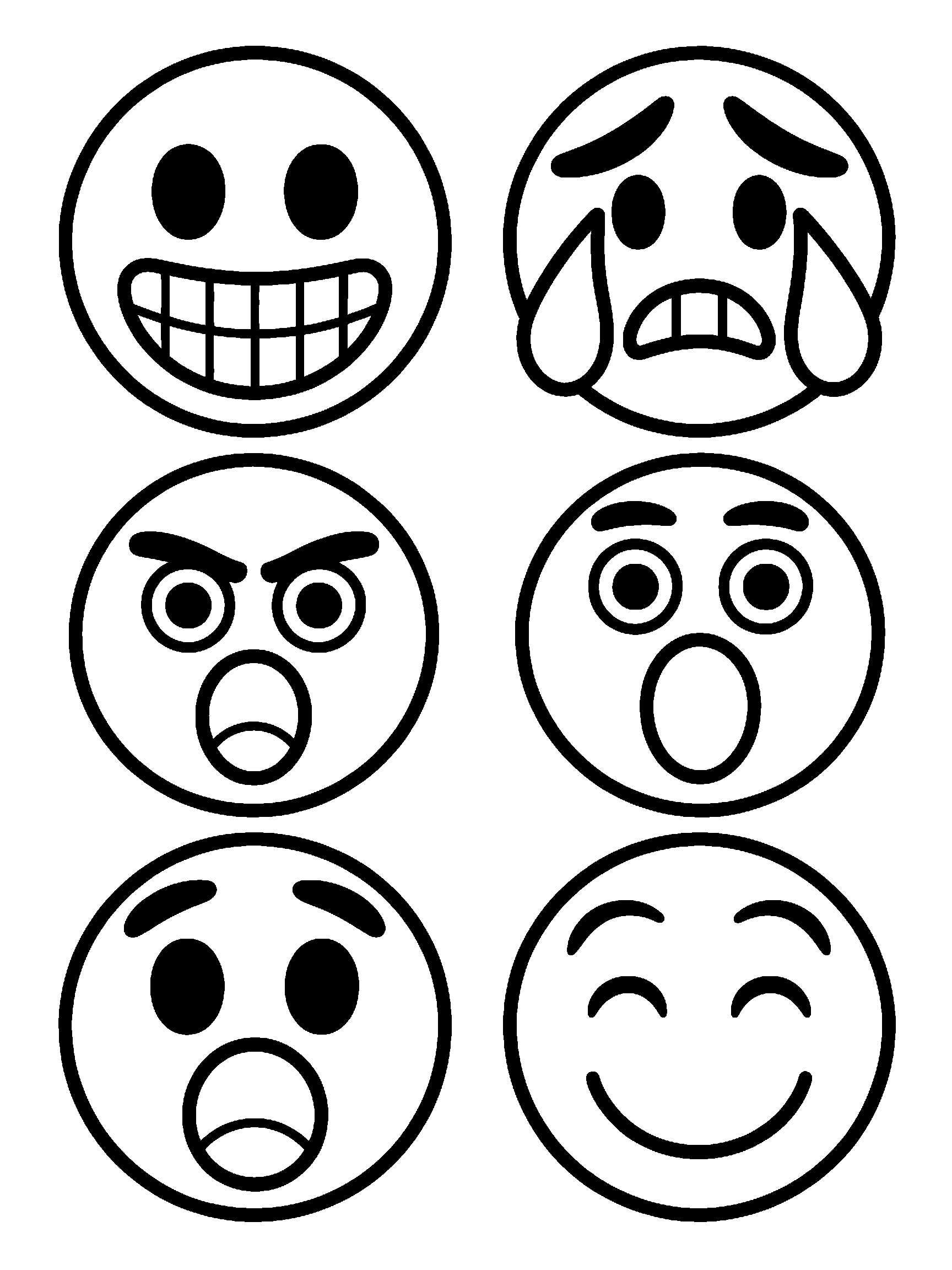
Open the feelings chart to print it
Use it three ways. Ask your child to name each face out loud. Let them pick a color for each feeling, since there's no right answer. Then keep it on the fridge and ask, "Which face are you right now?" Pointing is easier than talking when feelings run high.
Draw the Feeling They Can't Say
Some kids can't explain a feeling but can describe a picture of it. Ask what their mood would look like as an animal or the weather: a grumpy cloud, a brave little lion, a very tired sloth. Then type it into our coloring page maker and color it together. Your first page is free, no account needed.
Play a Game With Rules and Turns
Taking turns is one of the CDC's milestones for age 5, and games are the natural place to practice it. Bingo works well because younger kids can play without strong reading skills, and everyone gets to lose sometimes.
Practice Frustration With a Puzzle
A maze has dead ends built in. That makes it a small, safe place to practice feeling stuck. When your child hits one, try "That's frustrating. What else could you try?" instead of pointing at the right path. Word searches work the same way for older kids hunting the last word. For more on this, see our guide to the benefits of mazes for kids.
Build a Calm-Down Kit
A folder of easy coloring pages and a few crayons gives a child something to do with their hands while a big feeling settles. Keep it low-pressure: simple shapes, no rules. Our easy coloring pages and cute coloring pages are made for exactly this. Our list of quiet time activities has more ideas.
When Should You Talk to Your Child's Doctor?
The CDC's guidance is direct: "Don't wait. If your child is not meeting one or more milestones, has lost skills he or she once had, or you have other concerns, act early." Talk with your child's doctor, share your concerns and ask about developmental screening.
For school-age kids, worry is worth raising when a feeling won't lift or starts to take over. That might look like weeks of sadness or worry, pulling away from friends, or big changes in sleep, eating or school. You know your child best. If something feels off, a conversation with the pediatrician costs nothing. The AAP's emotional wellness pages are a good place to read more.
This article is general information for parents, not medical advice.
The Bottom Line
Emotional skills grow the same way reading does: a little at a time, with a patient adult nearby.
- By 4, most children comfort friends who are hurt or sad, and by 5 they take turns in games (CDC).
- Name feelings out loud, and accept the feeling while limiting the behavior (AAP).
- Friendships, fairness and self-control take over from 6 to 12.
- Games, drawing and puzzles give kids safe places to practice.
- If you're worried, don't wait. Talk to your child's doctor.
Want a calm ten minutes to start with? Print the feelings chart above, or pick a puzzle below.
Common questions
What are the stages of emotional development in children?+
Roughly: preschoolers learn to join play and calm down after a goodbye; by 4 most comfort friends who are hurt or sad, and by 5 they take turns in games, according to the CDC. School-age kids then work on friendships, fairness and self-control, and preteens on empathy and handling stress.
How can I help my child manage big emotions?+
Start by putting the feeling into words, which is the first tip on the American Academy of Pediatrics' list. Let your child know the feeling is OK even when the behavior isn't, stay calm yourself, and talk about what happened once everyone has cooled down. Practice through play, not lectures.
When should I worry about my child's emotional development?+
The CDC's advice is not to wait: if your child isn't meeting one or more milestones, has lost skills they used to have, or you're simply worried, talk with your child's doctor and ask about developmental screening. For older kids, persistent sadness, worry or big behavior changes are worth raising too.
Do coloring and puzzles really help emotional development?+
They're practice, not treatment. The AAP notes that play lets children explore emotions before they have words for them. A feelings chart gives kids a way to name what they feel, a board game practices taking turns, and a maze's dead ends are a small, safe place to practice frustration.